Engineers are copying nature's best tricks — shark scales, lotus leaves, whale fins, and pitcher plants — to build surfaces and structures that move through fluids faster, harvest energy more efficiently, and manage heat far better than conventional designs.
Imagine spending billions of dollars on research trying to design a surface that slides through water with minimal friction. Now imagine that a shark already had a solution — for free — roughly 450 million years ago.
This is the core promise of biomimicry: borrowing design ideas from living systems to solve hard engineering problems. And according to a sweeping new review published in the journal Biomimetics by researchers Farid Ahmed and Leonardo Chamorro from the University of Illinois Urbana-Champaign, we are only beginning to scratch the surface of what nature has to offer.
The review covers three big engineering challenges: controlling fluid flow and drag, understanding how flexible structures interact with moving fluids, and improving heat transfer through phase changes like boiling and condensation. In each domain, there are jaw-dropping solutions to be found in nature — and engineers are now learning how to copy them.
Every boat, submarine, and aircraft faces the same fundamental enemy: drag. Even a small reduction in drag translates to massive fuel savings at scale. So what does nature do about it? Quite a lot, it turns out.
Sharkskin Riblets
The tiny, tooth-like scales (called denticles) covering a shark’s skin are not just for show. They create microscopic ridges that stabilize the thin layer of turbulent flow right next to the surface, keeping it orderly and reducing friction. Studies show that well-designed synthetic riblets inspired by these denticles can cut skin friction by 5 to 15%, with some experimental setups hitting 35%. The key is getting the geometry right — if the ridges are too large, they actually increase drag. It’s a narrow optimal window, but when you hit it, the performance gains are real and passive (meaning no energy input required).
Superhydrophobic Surfaces: The Lotus Leaf Trick
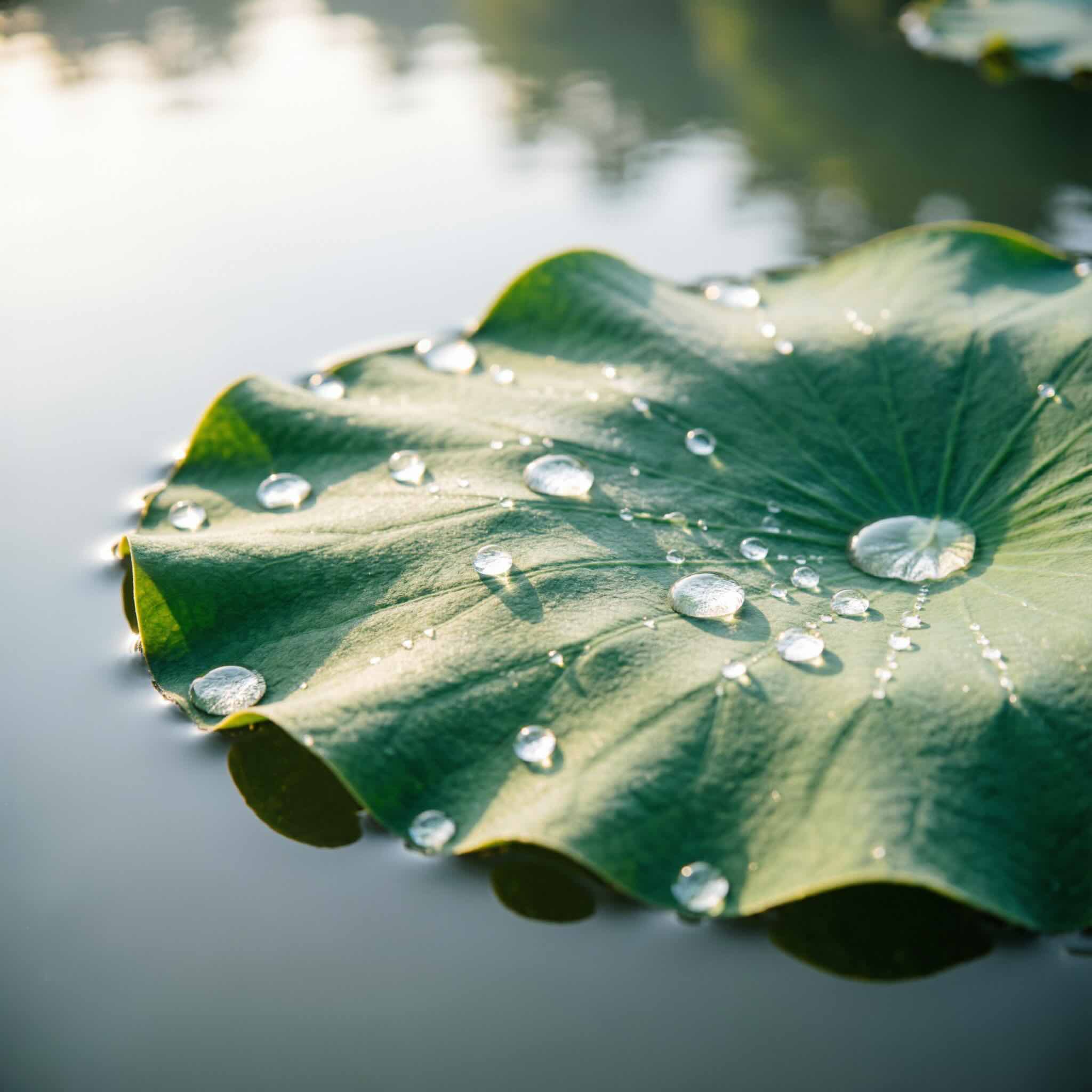
If you’ve ever seen water bead up and roll off a lotus leaf, you’ve witnessed superhydrophobicity in action. The leaf’s surface is covered with microscopic waxy bumps that trap tiny air pockets, so water droplets sit on a cushion of air rather than directly on the leaf. Engineers have replicated this with textured coatings that trap a thin air layer (called a ‘plastron’) against a moving surface, reducing the friction between the solid and the liquid by 14 to 50%. When researchers combined this approach with riblet geometry, drag reduction climbed to an impressive 57%. The challenge? Keeping that air layer intact under the high pressures of real ocean environments.
Gill-Inspired Water Jets
Fish gills don’t just extract oxygen — their geometry inspired a clever active drag-reduction strategy. By injecting tiny jets of water perpendicular to the hull surface (just like a gill emits fluid), engineers create a ‘vortex pad’ that thickens the low-friction zone near the wall and even provides a small forward thrust. This active method achieves up to 33-34% drag reduction but requires a continuous energy supply — a trade-off that makes it better suited to powered vessels than passive applications.
Biomimicry doesn’t stop at the water’s edge. The skies are full of biological flight innovations that engineers are keen to reverse-engineer.
Take humpback whale flippers. Despite being enormous, these flippers have bumpy, scalloped leading edges — called tubercles. Counterintuitively, these bumps improve aerodynamic performance at high angles of attack by generating small vortices that keep airflow attached to the surface longer. Engineers have applied this to wind turbine blades and aircraft wings, delaying the stall (the point at which a wing loses lift) and extending the effective operating range.
Birds offer another trick: the alula. This small tuft of feathers near a bird’s wrist acts like a leading-edge slat on a commercial airplane — it pops up at slow speeds to stop the wing from stalling. Researchers have built discrete and continuous alula-inspired devices into engineered wings, improving post-stall stability and gust tolerance.
Dragonfly wings take yet another approach. Their corrugated (ridged) profile creates small, stable air pockets in the troughs that act as a ‘virtual smooth surface,’ keeping airflow attached even in the low-speed, turbulent conditions that tiny flying robots face. While corrugations can increase drag at low angles of attack, their ability to maintain lift in chaotic conditions makes them valuable for micro air vehicle design.
Rigid structures and flowing fluids don’t always play well together. But nature’s answer to this is rarely to make things stiffer — it’s to make them smarter through flexibility.
Fish, for instance, don’t swim by brute force. They use body flexibility to manage vortex formation behind them, recycling the energy in their own wake. Flapping foils inspired by fish tails and insect wings have been shown to generate thrust with remarkable efficiency by carefully timing the shedding of swirling vortices. The sweet spot, researchers found, occurs at a Strouhal number (a ratio of flapping frequency and amplitude to forward speed) of roughly 0.2 to 0.3 — the same range fish and birds naturally operate in.
Flexible, plant-inspired filaments mounted on walls show similar multitasking talent: they passively reconfigure under flow, reducing drag on themselves while simultaneously promoting mixing and even enhancing heat transfer. Flexible plates coupled with piezoelectric materials (which convert mechanical strain to electricity) can harvest energy from fluid-induced flutter — essentially turning vibration into power.
A particularly exciting emerging application is using these fluid-structure interaction principles in phase-change heat transfer. Current boiling and condensation surfaces are mostly rigid. But what if the surface could flex to actively eject bubbles or guide droplets? The review identifies this as a major untapped opportunity.
Thermal management is one of the defining engineering challenges of our time. From data center servers to electric vehicle batteries to power electronics, getting rid of heat quickly and efficiently is critical. Here, biomimicry once again provides a remarkable toolkit.
The Namib Desert Beetle and Smart Condensation
The Namib beetle collects drinking water from morning fog by using a back covered in alternating hydrophilic (water-attracting) bumps and hydrophobic (water-repelling) valleys. Droplets form on the bumps and roll down to the beetle’s mouth. Engineers have copied this pattern to build condensation surfaces that are far more efficient than conventional ones: water nucleates readily on hydrophilic spots, then rolls off the hydrophobic background quickly, keeping the surface clear for more condensation. Nanostructured copper surfaces inspired by this concept have shown up to 98% improvements in condensation heat transfer compared to flat copper surfaces.
Leaves, Stomata, and Boiling Enhancement
A leaf is essentially a masterclass in fluid management. Water moves through a branching network of veins (the xylem-phloem system) and evaporates through tiny pores called stomata. Researchers have directly translated this architecture into boiling heat transfer surfaces. Re-entrant microcavities mimic stomata, providing stable bubble nucleation sites that are continuously re-fed with liquid through capillary channels modeled after leaf veins. Three-tier hierarchical surfaces — with macro-channels for bulk flow, micropillars for local capillarity, and nanoscale roughness for nucleation density — simultaneously improve multiple aspects of the boiling process, yielding large improvements in both heat transfer coefficient and critical heat flux (the maximum heat load before a surface fails).
The Pitcher Plant and Slippery Surfaces
The carnivorous Nepenthes pitcher plant uses a lubricated rim to make insects slide helplessly into its trap. Engineers have borrowed this idea to create ‘Slippery Liquid-Infused Porous Surfaces’ (SLIPS) — surfaces where a thin liquid film is locked into a nano-porous substrate, creating an almost frictionless interface. In boiling applications, these surfaces allow bubbles to nucleate and depart rapidly with minimal pinning, enabling controlled, efficient heat transfer. Some designs even program bubble pathways, steering vapor bubbles away from heat-sensitive zones.
So what are the frontiers that researchers are most excited about? The review points to several compelling directions.
Deep reinforcement learning (AI) is emerging as a powerful tool to discover bio-inspired control strategies that humans wouldn’t intuit. In simulations, AI-trained ‘fish’ learn to exploit the wake of a leader swimmer to increase efficiency by about 20% — a behavior real fish naturally display. The challenge is transferring these learned strategies from simulation into physical robots.
Hybrid multi-mechanism designs are another major frontier. Rather than borrowing one idea from nature, the best future systems may combine several — riblet geometry plus superhydrophobic coating plus active jetting, for example. A combined riblet-superhydrophobic surface already achieves 57% drag reduction, far beyond either strategy alone.
Compliant, FSI-enabled heat transfer surfaces represent perhaps the most underexplored opportunity. Current boiling surfaces are static. Nature, by contrast, never stops moving. Incorporating structural flexibility into future thermal management surfaces could unlock dynamic bubble and droplet control that passive rigid surfaces simply cannot achieve.
The authors also flag the importance of dealing with non-Newtonian fluids — fluids that don’t behave like water. Mucus, blood, polymer solutions, and biological slurries have complex flow properties that alter how bio-inspired surfaces perform. Most research to date assumes simple water-like fluids, leaving a rich and largely unexplored design space.
Finally, scalability and durability remain the biggest practical hurdles. Biological microstructures are elegant, but manufacturing them reliably over large areas — and keeping them functional over years of use — is a genuine engineering challenge. Self-healing surfaces inspired by biological regeneration and advanced fabrication techniques like 4D printing are promising paths forward.
Nature is not just a source of aesthetic inspiration — it is a proven engineering lab that has been running for hundreds of millions of years. From the microscopic ridges on a shark’s skin to the branching vein networks of a leaf, biological systems have converged on elegant, multifunctional solutions to the very fluid mechanics problems that keep engineers up at night.
What makes this review particularly valuable is its insistence on understanding the underlying physics, not just copying the shape. A shark’s denticles work because of how they interact with turbulent vortices at a specific scale — not simply because they look cool. Translate that principle correctly into an engineered surface, and you get real, measurable performance gains. Miss the physics, and you just have an expensive decoration.
As fabrication technology, AI-driven optimization, and multiphysics modeling continue to improve, the gap between what nature can do and what engineers can build is closing. The future of fluid engineering may well be written in biology.
Biomimicry
The practice of imitating designs, structures, or processes found in nature to solve human engineering problems. - More about this concept in the article "Biomimicry Boosts Additive Manufacturing | Cooler, Greener Buildings".
Turbulent Flow
A chaotic, swirling pattern of fluid motion (opposite of smooth "laminar" flow) that increases drag and energy loss on surfaces. - More about this concept in the article "Revolutionizing Turbulent Flow Modeling with AI: A Game-Changer for Engineering Applications".
Drag
The resistance force that a fluid exerts on a moving object, opposing its motion and costing energy to overcome.
Heat Transfer Coefficient
A measure of how efficiently heat moves between a surface and a fluid — the higher it is, the better the cooling or heating performance.
Fluid-Structure Interaction (FSI)
The way a flexible solid (like a fish fin or a wing) and the fluid around it influence each other's behavior when they move together.
Ahmed, F.; Chamorro, L.P. On Bio-Inspired Strategies for Flow Control, Fluid–Structure Interaction, and Thermal Transport. Biomimetics 2026, 11, 143. https://doi.org/10.3390/biomimetics11020143