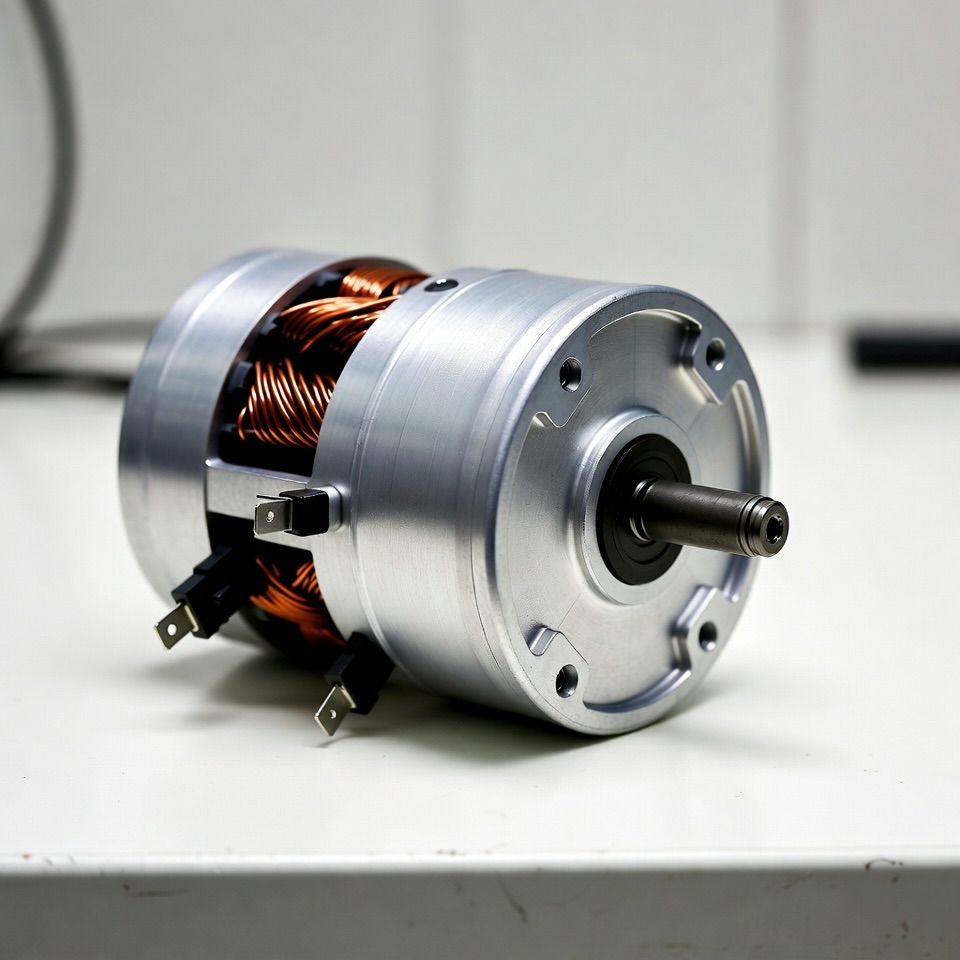
Right now, as you're reading this, dozens of electric motors are working around you. They're spinning inside your computer's cooling fan, vibrating your phone when a notification arrives, and perhaps even adjusting the focus in your camera. Yet despite being one of humanity's most ubiquitous inventions, the electric motor remains a mystery to many. How does electricity—invisible flowing charges—transform into the physical rotation that powers everything from hard drives to Tesla vehicles?
The answer is beautifully simple: electric motors are machines that convert electrical energy into mechanical energy through the interaction of magnetic fields. But as we'll discover, this simple principle manifests in dozens of ingenious designs, each optimized for different applications. Whether you're an engineering student preparing for exams or simply curious about the technology that powers modern life, this guide will demystify the electric motor from fundamental physics to real-world applications.
Before we dive into motor designs, we need to understand the single physical principle that makes all electric motors possible: when an electric current flows through a conductor in the presence of a magnetic field, the conductor experiences a force.
This phenomenon, discovered by Michael Faraday in the 1820s, is governed by the Lorentz force law. When a straight conductor carrying current "I" sits in a magnetic field with flux density "B", it experiences a force "F" given by:
F = I × L × B × sin(θ)
Where:
When the conductor is perpendicular to the magnetic field (θ = 90°), the force is maximized since sin(90°) = 1.
Explore how electric current and magnetic fields create motion
Torque: τ = 0.00 N·m
Force: F = I × L × B = 5.0 × 0.1 × 1.5 = 0.00 N
Rotation Angle: θ = 0°
Angular Velocity: ω = 0.00 rad/s
Uses a commutator to switch current direction, maintaining continuous rotation.
The direction of this force follows the right-hand rule: point your fingers in the direction of current flow, curl them toward the magnetic field direction, and your thumb points in the direction of force. This simple rule is the compass that guides every electric motor design.
A force on a single wire is interesting physics, but not particularly useful. The genius of the electric motor lies in arranging conductors in a loop or coil that can rotate. When current flows through a rectangular coil placed between two magnetic poles, opposite sides of the coil experience forces in opposite directions, creating a torque that causes rotation.
The torque (τ) produced by a single-turn coil is:
τ = B × I × A × sin(θ)
Where:
For a coil with N turns, multiply the torque by N:
τ = N × B × I × A × sin(θ)
Notice something crucial: the torque depends on sin(θ), which means it varies as the coil rotates. When the coil is perpendicular to the magnetic field (θ = 90°), torque is maximum. When it's parallel (θ = 0°), torque becomes zero. This creates a problem: how do we keep the coil spinning continuously?
Early motor designers solved the discontinuous torque problem with an ingenious device called a commutator—essentially a rotary electrical switch. In a basic DC motor, the commutator reverses the current direction in the coil every half rotation, ensuring the torque always acts in the same rotational direction.
Here's how it works: the commutator consists of a split ring attached to the rotating coil (called the armature). Stationary carbon brushes press against this ring, supplying current. As the coil rotates past the vertical position where torque would normally reverse, the split ring segments swap contact with the brushes, flipping the current direction. This keeps the magnetic forces pushing the coil in the same rotational direction.
The switching frequency equals the rotation speed. A motor spinning at 3,000 RPM switches current direction 3,000 times per minute—that's 50 times per second. This rapid switching, combined with multiple coils offset at different angles, creates remarkably smooth rotation.
Brushed DC Motors are the most straightforward motor design. They consist of:
Interactive illustration showing the fundamental parts of a DC motor
The relationship between voltage, current, and motor speed follows from basic electromagnetic principles. The back EMF (electromotive force) generated by the spinning coil in the magnetic field opposes the applied voltage:
V_applied = I × R + K_e × ω
Where:
The mechanical power output relates to torque and speed:
P_mech = τ × ω
Where P_mech is mechanical power in watts (W).
DC motors excel in applications requiring variable speed control and high starting torque—think power tools, electric vehicles, and robotics. However, the brushes wear out over time, requiring maintenance and limiting maximum speed.
Brushless DC Motors (BLDC) eliminate the commutator and brushes entirely by using electronic switching. External circuitry (typically an ESC—Electronic Speed Controller) switches current between three or more electromagnet coils in the stator, while permanent magnets form the rotor. Position sensors or sensorless algorithms determine when to switch coils.
BLDCs offer higher efficiency (often 85-90% vs. 75-80% for brushed motors), longer lifespan, and higher speed capability. They've become dominant in drones, computer fans, and electric vehicles. The tradeoff is increased control complexity and cost.
While DC motors convert steady current into motion, AC motors exploit the inherent oscillation of alternating current. The two main types operate on fascinatingly different principles.
AC Induction Motors (also called asynchronous motors) are the most common motors in industrial applications. Unlike DC motors, the rotor contains no electrical connections—no brushes, no commutator, nothing. Instead, alternating current in the stator coils creates a rotating magnetic field that induces currents in the rotor through electromagnetic induction (the same principle behind transformers).
Interactive illustration showing how rotating magnetic fields create torque
These induced currents create their own magnetic field in the rotor, which tries to align with the stator's rotating field. The rotor spins to "catch up" with the rotating field but never quite reaches it—there must be some relative motion to maintain induction. This speed difference is called slip:
Slip (s) = (N_sync - N_rotor) / N_sync × 100%
Where:
The synchronous speed depends on AC frequency and number of magnetic poles:
N_sync = 120 × f / P
Where:
For 60 Hz AC and a 4-pole motor: N_sync = 120 × 60 / 4 = 1,800 RPM. The actual rotor speed might be 1,750 RPM, giving a slip of 2.8%.
Induction motors are incredibly robust (no wearing brushes), efficient, and relatively inexpensive. They power industrial machinery, HVAC systems, and appliances worldwide. Their main limitation is that speed control requires varying the AC frequency, which traditionally required expensive variable-frequency drives (though modern power electronics have made this more accessible).
Synchronous Motors differ from induction motors in one key aspect: the rotor contains permanent magnets or separately-excited electromagnets that lock onto the rotating magnetic field and spin at exactly the synchronous speed—no slip. This makes them more efficient and allows precise speed control, crucial for applications like industrial robots and CNC machines.
Stepper motors represent a fascinating middle ground between continuous rotation motors and precise positioning systems. Instead of smooth rotation, steppers move in discrete angular increments—typically 1.8° or 0.9° per step, corresponding to 200 or 400 steps per revolution.
The stator contains multiple electromagnet coils arranged in groups called phases (commonly 2 or 4 phases). By energizing these coils in a specific sequence, the controller creates a rotating magnetic field that pulls the permanent magnet or toothed rotor along step by step.
For a motor with 200 steps per revolution, the angular resolution is:
θ_step = 360° / steps_per_revolution = 360° / 200 = 1.8°
Microstepping techniques can subdivide these steps further by varying current levels, achieving resolutions of 0.225° or better.
Steppers excel when you need to know exactly where something is without feedback sensors—a concept called open-loop control. They're ubiquitous in 3D printers (positioning the print head), CNC machines (controlling cutting tools), and scanners (moving the optical sensor). The tradeoff is lower top speed and efficiency compared to other motor types.
Perfect energy conversion from electrical to mechanical power remains impossible in real-world motors. Understanding losses helps engineers optimize designs and users select appropriate motors.
The efficiency (η) is defined as:
η = P_out / P_in × 100%
Where:
Major loss mechanisms include:
Modern motors achieve impressive efficiencies:
That remaining 2-5% in the best motors might seem trivial, but in a 100 kW industrial motor running continuously, even 2% loss represents 2,000 watts of waste heat—and higher electricity bills.
Choosing the right motor requires balancing multiple factors:
Speed Requirements: Stepper motors top out around 2,000 RPM, while brushless DC motors can exceed 100,000 RPM. Universal motors (used in vacuum cleaners and power tools) can reach 30,000 RPM but are noisy and less efficient.
Torque Characteristics: DC motors provide high starting torque, crucial for applications like electric vehicles and winches. Induction motors start with lower torque but maintain it well across their speed range.
Control Precision: Steppers and servo systems (closed-loop motors with position feedback) enable precise positioning. Simple AC induction motors provide less precise speed control without additional electronics.
Environment: Brushless motors tolerate dust and moisture better than brushed motors. Totally enclosed fan-cooled (TEFC) motors suit harsh industrial environments.
Duty Cycle: Continuous-duty motors withstand 24/7 operation. Intermittent-duty motors (like window lift motors in cars) are smaller and cheaper but overheat if run continuously.
Cost: Brush DC motors are cheapest; servo systems most expensive. Induction motors offer the best balance for industrial applications.
The diversity of electric motor applications is staggering:
Micro-motors in smartphones provide haptic feedback through tiny vibration motors smaller than a fingernail, spinning eccentric weights at high speed.
Consumer electronics rely on BLDC fans (quieter and more efficient than older brushed designs) and precision stepper motors in cameras for autofocus and zoom.
Electric vehicles use AC induction motors (Tesla Model S) or permanent magnet synchronous motors (Nissan Leaf) producing 200-400 kW—equivalent to 268-536 horsepower—with instant torque delivery and regenerative braking capability.
Industrial applications employ motors from 1 kW to several megawatts. A single large synchronous motor in a steel mill might produce 20 MW (26,800 horsepower) to drive rolling equipment.
Robotics combines multiple motor types: BLDC motors for joints requiring smooth motion, steppers for precise positioning, and tiny servo motors for grippers and sensors.
Renewable energy uses motors in reverse—wind turbines contain enormous generators (motors running backward) converting mechanical rotation into electricity, some exceeding 10 MW capacity.
Engineers and researchers in electric motor technology emphasize several emerging trends that promise to reshape the field. The ongoing transition to more sustainable energy systems has accelerated development of ultra-high-efficiency motor designs, with some prototype machines achieving over 98% efficiency through advanced materials and optimized magnetic circuit designs.
The integration of smart electronics directly into motor housings represents another significant shift. Modern motors increasingly incorporate sensors, microcontrollers, and communication interfaces, transforming them from simple electromechanical devices into intelligent systems capable of self-diagnosis, predictive maintenance, and seamless integration with industrial IoT networks.
Material science continues to push boundaries, with rare-earth permanent magnets enabling unprecedented power density in compact packages, though supply chain concerns are driving research into alternative materials. Wide-bandgap semiconductors like silicon carbide enable smaller, more efficient motor controllers that switch at higher frequencies with lower losses.
Perhaps most intriguingly, the distinction between motor types is blurring. Some advanced designs combine principles from different motor families—for instance, switched reluctance motors that offer brushless simplicity with the control characteristics of steppers, or hybrid synchronous motors that seamlessly transition between operating modes based on load conditions.
The experts note that we're far from having exhausted the possibilities of electric motor technology. After nearly 200 years of development, motors continue to become more efficient, more compact, more intelligent, and more integral to modern civilization.
When you encounter a motor datasheet, several key specifications determine performance:
Voltage Rating: The designed operating voltage. Running below this voltage reduces torque; running above it can damage insulation.
Current Rating: Includes both no-load current (at zero torque) and stall current (at zero speed, maximum torque). Motor controllers must handle stall current without damage.
Speed Rating: Usually given in RPM (revolutions per minute) at rated voltage and load. No-load speed is higher than loaded speed.
Torque Rating: Continuous torque the motor can safely produce. Peak torque (for brief periods) may be 2-3× higher.
Power Rating: Mechanical power output, typically in watts or horsepower. Remember: 1 hp = 746 W.
The relationship between these follows from the equations we've explored:
P = τ × ω = τ × (2π × RPM / 60)
For example, a motor producing 5 N·m torque at 3,000 RPM:
P = 5 × (2π × 3000 / 60) = 5 × 314.16 = 1,571 W ≈ 2.1 hpDifferent motor types require different speed control strategies:
DC Motor Speed Control: Varies the applied voltage. Pulse Width Modulation (PWM) achieves this efficiently by rapidly switching full voltage on and off. The motor responds to the average voltage:
V_avg = V_supply × duty_cycle
Where duty_cycle is the fraction of time the voltage is on (0 to 1).
AC Motor Speed Control: Requires varying the frequency of AC supply using a Variable Frequency Drive (VFD). Since synchronous speed N_sync = 120 × f / P, reducing frequency proportionally reduces speed.
Stepper Motor Speed Control: Simply changes the rate at which step commands are sent. Faster pulse rate = faster rotation.
Electric motors represent one of humanity's most successful technologies—a simple physical principle refined through endless iterations into thousands of optimized forms. From the vibration motor in your smartwatch to the traction motor in an electric train, these devices silently convert invisible electrical energy into the physical motion that powers modern civilization.
Understanding motors connects you to fundamental physics (electromagnetic forces), practical engineering (design trade-offs and efficiency optimization), and real-world impact (energy consumption and sustainability). The next time you press a button and something moves, you'll recognize the elegant dance of magnetic fields and currents happening inside—and perhaps appreciate the nearly two centuries of innovation that made it possible.
The motor that Michael Faraday first demonstrated in 1821 has grown into a family of technologies producing mechanical work more efficiently, reliably, and controllably than any previous invention. As we transition toward electric transportation and renewable energy, electric motors will only become more central to human civilization. Whether you're designing the next generation of drones, troubleshooting industrial equipment, or simply satisfying your curiosity, understanding how electric motors work gives you insight into the technology that turns our electrical grid into physical motion.
Try the interactive simulator above to experiment with motor principles yourself—there's no substitute for hands-on exploration when it comes to developing intuition for electromagnetic phenomena. The physics is simple, but the applications are limitless.