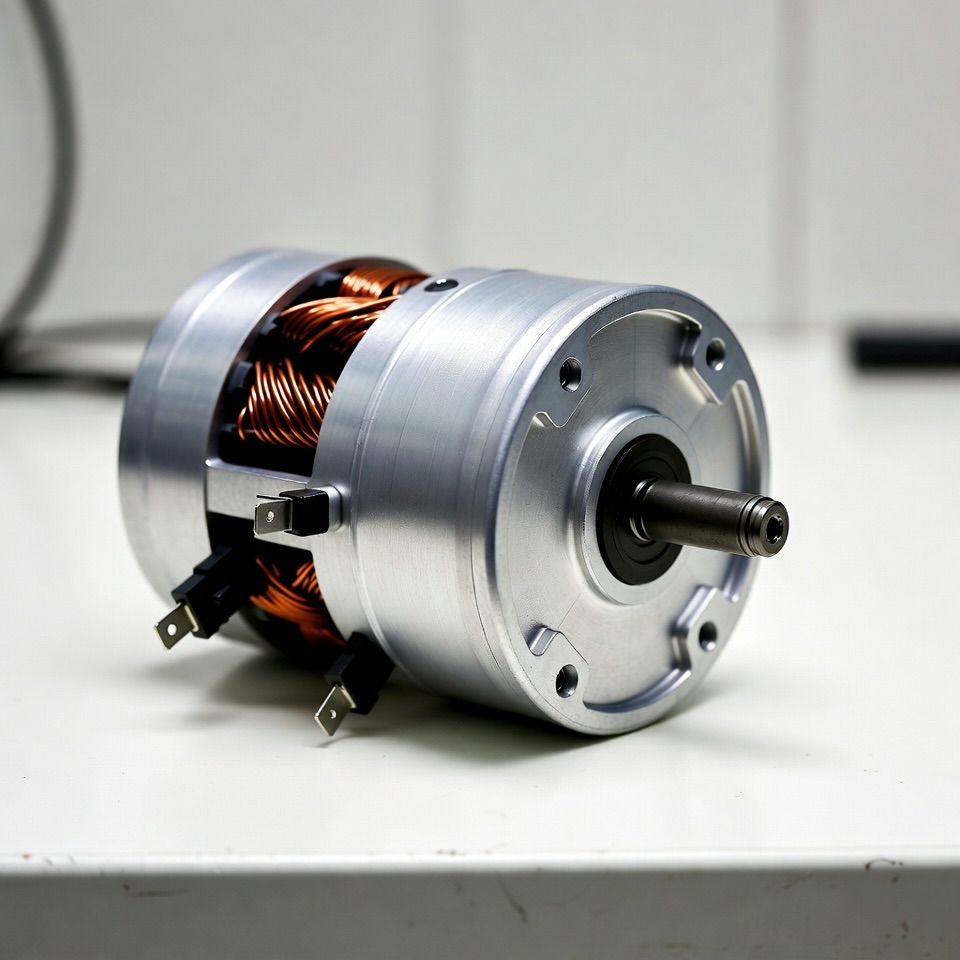
Recent research uses machine learning—specifically Bayesian Neural Networks—to directly predict high-frequency circuit designs from desired performance, reducing simulation time by over 80% compared to traditional methods.
Imagine trying to solve a maze backwards—from the finish line to the starting point. That's what a new research paper proposes for designing high-frequency circuits, flipping the usual design flow on its head using Machine Learning (ML). And guess what? It works—and it’s much faster!
In their study, researchers present a groundbreaking way to optimize circuits using ML-generated inverse maps, cutting down simulations by over 80% while boosting accuracy.
Let’s break it down in plain terms, with emojis and excitement included.
High-frequency circuits are essential for tech like:
But designing them is like navigating a jungle—you need to simulate endlessly to get things just right. Traditional methods like space mapping (SM) help, but they still involve hundreds of time-consuming simulations.
So, what if we could just guess the perfect circuit design from the desired result?
Rather than tweaking the circuit until it behaves the way we want (forward mapping), this research flips the process using Machine Learning:
"Tell me the performance you want, and I’ll tell you the design!"
They trained a machine learning model—specifically a Bayesian Neural Network (BNN)—to reverse-engineer circuit parameters based on performance goals.
Desired Output → Machine Learning Model → Circuit Design
This leap is called inverse surrogate modeling—a new direction for circuit optimization that saves time and delivers better results.
They focused on a microstrip low-pass filter, a common RF component that lets low frequencies pass while blocking higher ones.
Key design variables:
These values shape how the circuit behaves over frequency.
They used Latin Hypercube Sampling (LHS) to spread out training data efficiently across the design space.
The BNN model was trained to learn:
Performance Response (like a desired cutoff frequency) Design Parameters (L, W, S)
Unlike traditional neural nets, Bayesian models also estimate uncertainty—super helpful for complex, nonlinear systems.
Model Performance (on test data):
That’s very accurate for predicting physical design values from desired output specs!
Here’s how the inverse model compared to traditional space mapping:
| Metric | Traditional SM | Inverse ML SM |
|---|---|---|
| Coarse Simulations | 580 | 31 |
| Fine Simulations | 7 | 6 |
| Accuracy | Good | Even Better |
| Convergence Speed | Slower | Faster |
| Parameter Stability | Fluctuating | Stable |
That’s a massive win in both speed and accuracy!
The current study focuses on simulation-based validation. The next steps for this exciting research direction include:
Real-world Prototyping: Fabricating the ML-designed circuits and validating them in the lab.
More Complex Designs: Applying the model to multi-variable, nonlinear, or active components (like amplifiers or resonators).
Wider Adoption: Integrating inverse modeling into commercial RF design software (hello, COMSOL and MATLAB users!).
Comparative Benchmarking: Benchmarking against other Machine Learning models like Support Vector Machines or Gaussian Processes for different circuit types.
In short: Machine Learning isn’t just speeding up design—it’s redefining it.
This paper proves that Machine Learning-driven inverse modeling is no longer a future dream—it’s here, and it's making RF design smarter, faster, and way more efficient.
For engineers working in microwave and RF domains, adopting these AI-enhanced techniques could shave days or even weeks off your design cycle.
So the next time you’re designing a filter or a matching network, just ask yourself:
“Why go forward… when inverse is the faster path?”
Machine Learning (ML) - A type of artificial intelligence where computers learn patterns from data—kind of like teaching a dog new tricks, but for math and code! - More about this concept in the article "Generative AI vs Wildfires | The Future of Fire Forecasting".
Bayesian Neural Network (BNN) - A special kind of neural network that not only makes predictions but also tells you how confident it is. Think of it as an AI that knows when it's guessing.
Inverse Modeling - Instead of guessing how a design performs, you start with the performance you want and work backward to find the design that makes it happen.
High-Frequency Circuit - An electronic circuit that works with signals above 1 GHz (like Wi-Fi, radar, or 5G). These circuits need super precise designs!
Low-Pass Filter - A type of circuit that lets low frequencies through but blocks high ones—like a gatekeeper for your Wi-Fi signals.
Space Mapping (SM) - An optimization trick that uses a simple (coarse) model to guide you toward an accurate (fine) one—like using a sketch before painting a masterpiece.
Surrogate Model - A fast, simplified version of a complex simulation—used to save time without losing too much accuracy. Kind of like a movie trailer instead of watching the full film. - More about this concept in the article "Building Smarter, Greener | Optimizing Modular Construction Supply Chains with AI & Multi-Agent Systems".
Electromagnetic (EM) Simulation - A computer simulation that shows how electric and magnetic fields behave in a circuit—basically a digital lab test.
Latin Hypercube Sampling (LHS) - A smart way to pick test points from a wide range of possibilities, so you cover more ground with fewer guesses.
Mean Absolute Error (MAE) - A metric that tells you how close your model's guesses are to the real answers—lower is better. - More about this concept in the article "Smart Trains, Greener Cities | How AI-Optimized Scheduling Slashes Carbon Emissions in Hangzhou".
Radio Frequency (RF) - Refers to the range of electromagnetic waves used for wireless communication—like Wi-Fi, Bluetooth, and mobile signals. It’s how your phone talks to the internet without wires! - More about this concept in the article "Smart Skins for the Future: Frequency-Selective Surfaces Revolutionizing Buildings".
Davalos-Guzman, J.; Chavez-Hurtado, J.L.; Brito-Brito, Z. Accelerating High-Frequency Circuit Optimization Using Machine Learning-Generated Inverse Maps for Enhanced Space Mapping. Electronics 2025, 14, 3097. https://doi.org/10.3390/electronics14153097
From: Intel Corporation; The Jesuit University of Guadalajara; Centre Tecnològic de Telecomunicacions de Catalunya (CTTC/CERCA).