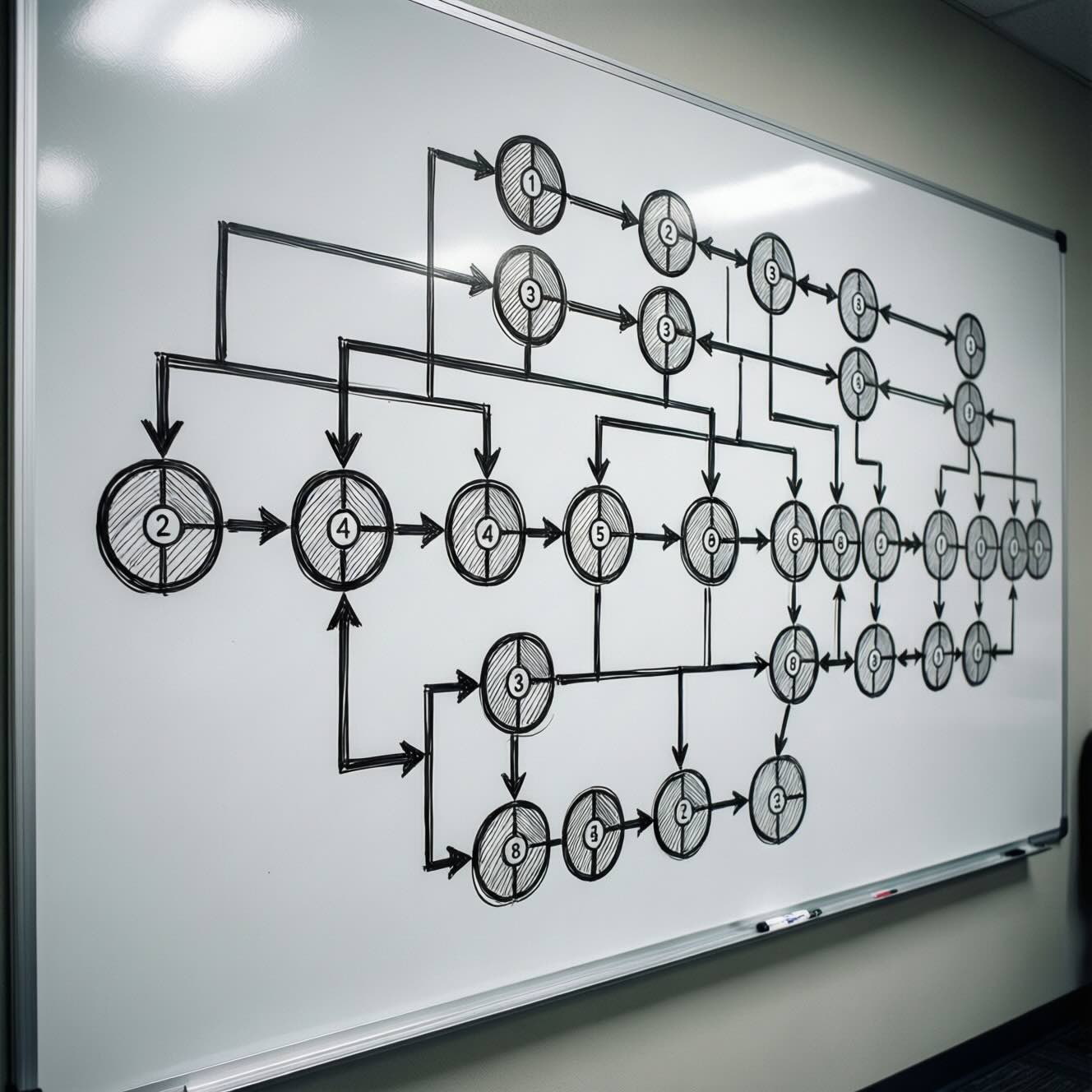
Project management in engineering isn't just about keeping track of tasks—it's about understanding dependencies, calculating timelines, and identifying bottlenecks before they derail your schedule. Today, we're diving deep into one of the most powerful tools in a project manager's arsenal: the PERT (Program Evaluation and Review Technique) chart.
Whether you're managing a software deployment, coordinating a construction project, or planning a research initiative, understanding PERT methodology can transform how you approach scheduling and resource allocation. Let's explore how this proven technique works, its mathematical foundations, and when it shines brightest.
The method originated in the late 1950s when the U.S. Navy's Special Projects Office created it specifically to manage the scheduling complexities of the Polaris missile submarine project. PERT was designed to handle the uncertainty inherent in large, complex projects where task durations couldn't be precisely predicted (Kelley & Walker, 1959; Malcolm et al., 1959).
Unlike simple to-do lists or basic schedules, PERT charts visualize:
Think of it as a roadmap that not only shows you where you need to go, but also highlights which routes are flexible and which ones you absolutely cannot afford to delay.
Our FlowPERT application lets you build PERT charts interactively as you learn. Try creating a simple project while exploring the methodology explained below.
At its core, PERT uses network analysis and statistical methods to calculate project timelines. Let's break down the key calculations.
One of PERT's most distinctive features is its approach to estimating task duration. Instead of a single "best guess," PERT asks for three estimates:
The expected duration is calculated using a weighted average that gives more importance to the most likely estimate:
Expected Duration (TE) = (O + 4M + P) / 6This formula comes from the Beta distribution, which better models real-world task completion times than simple averages (Malcolm et al., 1959). The weighting of 1:4:1 reflects the assumption that the most likely scenario is four times more probable than either extreme.
Example: Installing a server
TE = (2 + 4×4 + 10) / 6 = 28 / 6 = 4.67 hoursThe forward pass moves through the network from start to finish, calculating the earliest each task can begin and end.
Early Start (ES): The earliest a task can begin, considering all predecessor tasks
ES = Maximum(Predecessor EF + Lag Time)For tasks with no predecessors: ES = 0
Early Finish (EF): The soonest possible completion time for a task
EF = ES + DurationExample:
The backward pass moves from the project end to the beginning, determining the latest each task can start/finish without delaying the project.
Late Finish (LF): The final deadline for completing a task without impacting the overall project timeline
LF = Minimum(Successor LS - Lag Time)For final tasks: LF = Project Duration
Late Start (LS): The latest a task can begin without causing delays
LS = LF - DurationContinuing our example (Project Duration = 11):
Slack represents scheduling flexibility—how much a task can be delayed without impacting the project deadline.
Slack = LS - ESor equivalently:
Slack = LF - EFIn our example:
The critical path consists of all tasks where Slack = 0. These tasks have no scheduling flexibility—any delay directly extends the project timeline.
In our example: A → C → D forms the critical path (11 days total).
Task B has 1 day of slack, meaning it could start as late as day 6 instead of day 5 without affecting the project completion.
PERT supports four types of task dependencies (Project Management Institute, 2017):
Finish-to-Start (FS) - Most common
Successor ES = Predecessor EF + LagExample: You can't paint until plastering is finished.
Start-to-Start (SS)
Successor ES = Predecessor ES + LagExample: Electrical wiring can start 2 days after framing begins (both run in parallel).
Finish-to-Finish (FF)
Successor LF = Predecessor LF + LagExample: Quality testing must finish when development finishes.
Start-to-Finish (SF) - Rare
Successor LF = Predecessor ES + LagExample: Night security shift can't end until day security shift starts.
Both PERT and Gantt charts are staples of project management, but they serve different purposes and excel in different scenarios.
Strengths:
Weaknesses:
Ideal Use Cases:
Strengths:
Weaknesses:
Ideal Use Cases:
In practice, many project managers use both. PERT for initial planning and critical path analysis, then Gantt for day-to-day execution and team communication. Modern project management software often integrates both views, letting you switch between network diagrams and timeline charts as needed.
Project management practitioners who've worked with PERT across multiple industries offer nuanced insights that textbooks often miss.
One common observation is that PERT's three-point estimation, while theoretically sound, faces practical challenges. Teams often struggle to provide meaningful optimistic and pessimistic estimates, defaulting to arbitrary multiples of their most-likely guess. The solution lies in historical data: organizations that maintain databases of actual task durations from past projects can calibrate their estimates with real-world evidence rather than hunches.
The critical path concept, while powerful, can create tunnel vision. Experienced practitioners emphasize monitoring near-critical paths—task sequences with minimal slack that could easily become critical if estimates slip. Ignoring these "runner-up" paths has derailed many projects when initially non-critical tasks encountered problems.
Another insight concerns stakeholder communication. While PERT's network diagrams are analytically superior, they often confuse clients and executives. Successful project managers translate PERT insights into simplified formats for stakeholders while maintaining the PERT model as their planning foundation. Think of PERT as your detailed engineering drawings and Gantt as the architect's rendering you show clients.
The statistical rigor of PERT also requires honest acknowledgment of its limitations. The independence assumption—that task durations are statistically independent—rarely holds in practice. If your database server fails, it likely impacts multiple dependent tasks simultaneously. Smart teams use PERT for its structural insights while supplementing it with Monte Carlo simulation or scenario planning for more realistic risk analysis.
Finally, veteran project managers note that PERT's greatest value often comes during planning rather than execution. The discipline of mapping dependencies, identifying the critical path, and thinking through three scenarios forces teams to deeply understand their project. This upfront mental work prevents problems before they occur, even if the actual PERT chart becomes less central once work begins.
PERT charts represent more than just a scheduling technique—they're a systematic way of thinking about complex work. By forcing you to identify dependencies, estimate with uncertainty, and understand which tasks truly drive your timeline, PERT creates clarity in chaos.
The mathematics might seem intimidating at first, but modern tools like our FlowPERT application handle the calculations automatically. Your job is to understand the concepts, map your project accurately, and use the insights PERT provides to make better decisions.
Whether you choose pure PERT, pure Gantt, or a combination, the key is matching the tool to your project's needs. For innovative, complex work with significant uncertainty, PERT's analytical power is unmatched. For routine, well-understood projects, simpler tools may suffice.
The best project managers maintain flexibility, using the right tool for each situation while understanding the principles behind all of them. PERT, despite being developed in the 1950s, remains remarkably relevant precisely because it addresses timeless challenges: uncertainty, complexity, and interdependence.
Now that you understand the methodology, why not try it yourself with the FlowPERT tool? Map out your next project, experiment with three-point estimates, and discover your critical path. Theory becomes truly valuable only when applied to real problems.
Primary Sources:
Modern Applications:
Statistical Foundations:
Comparative Studies:
For interactive learning, the Project Management Institute (PMI) offers workshops and certifications covering PERT and related techniques. The Stanford Online platform also provides excellent courses on network analysis and project scheduling.