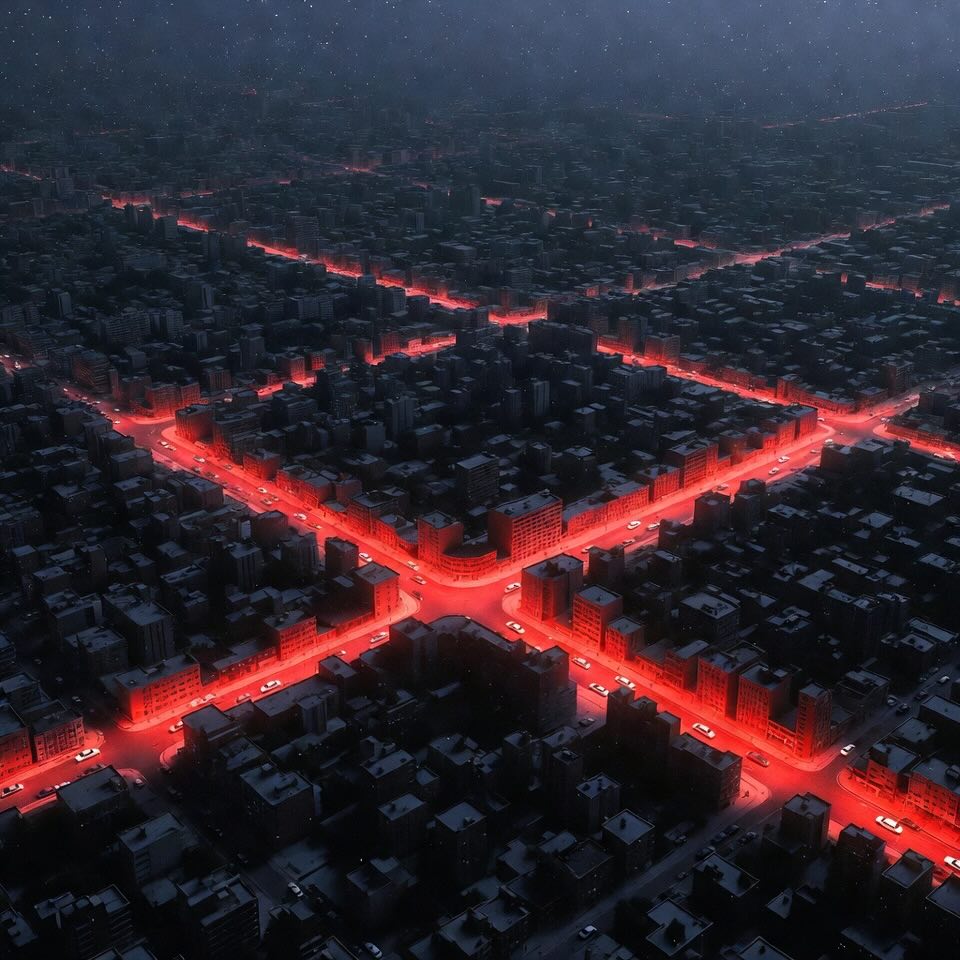
This research proposes a peer-to-peer energy market design using Dynamic Operating Envelopes (DOEs) to enable uniform electricity pricing across all users, ensuring fair trading while maintaining grid stability and maximizing social welfare.
Imagine your rooftop solar panel producing more energy than you need. Instead of letting it go to waste, wouldn't it be amazing to sell it to your neighbor down the street, just like you'd share a basket of fresh tomatoes? That's the dream behind peer-to-peer (P2P) energy markets — communities trading clean, local energy among themselves.
But there’s a catch.
The electric grid isn’t just a passive wire — it has limits! Think of it like a highway with speed and weight limits. If too many people drive energy through the same line at the same time, it can overload — or "break the rules" of voltage and thermal constraints. And guess what? That often leads to different prices depending on where you live, which can feel unfair.
So how do we create a system that's both technically reliable and socially fair?
That’s where this research paper steps in. The paper proposes a novel market design that uses Dynamic Operating Envelopes (DOEs) to ensure uniform pricing for everyone — regardless of their location on the grid.
In traditional energy systems, prices vary by location to reflect stress on the grid. That’s known as locational pricing. It’s technically smart but socially tricky — people living farther from substations often get higher prices.
To balance this, the researchers introduce DOEs — limits tailored for each household, calculated to ensure everyone stays within safe operating limits of the grid.
Think of a DOE like a personal energy budget:
"You can inject or draw this much power today — no more, no less — and still keep the grid safe."
By assigning these tailored energy limits to each user, the system allows everyone to participate equally and still maintain grid stability.
In this new system, prosumers (producers + consumers) can trade energy with each other using a single, uniform price. No matter where you live on the grid, the price is the same. Fair and square!
But how?
The researchers explore two versions of this fair trading system:
Each user follows their DOE and trades energy at a fixed price. This works well — but it can be a bit rigid.
Sometimes, users can’t fully use their DOE, or need a little extra. So…
This clever upgrade allows people to trade their unused DOE capacity.
Say Alice can export 5 kW but only wants to send 3. Bob, meanwhile, wants to export 7 kW but is only allowed 5. Now, Bob can "buy" 2 kW of Alice's unused limit.
This system:
To test their ideas, the researchers ran simulations using a modified IEEE 13-node test feeder — a standard model used to represent neighborhood-scale electric grids.
Here’s what they modeled:
They compared three market setups:
Fairness: Everyone gets the same price, regardless of location
Social Acceptance: No one feels punished for their address
Grid Stability: No overloads — voltage limits respected
Budget Balance: No money left on the table — total trades sum to zero
More Income: Every aggregator earned $2.12 more on average compared to locational pricing
Flexibility: DOE limit trading helped overcome rigid limits, avoiding infeasible situations
Even when the system was under stress (like EVs all charging at once), the DOE trading allowed the market to operate smoothly — something the rigid system without limit trading couldn’t handle.
This model opens the door to a future where local energy sharing becomes as common as online shopping. Here's what could be next:
With more renewable energy on the way, and EV adoption rising fast, these market models could turn neighborhoods into microgrids that are not just sustainable — but financially rewarding.
Uniform pricing in peer-to-peer energy markets isn't just an academic idea — it's a practical, fair, and scalable solution for the green energy transition.
With innovations like DOEs and smart market design, we’re not just empowering the grid — we’re empowering people.
Prosumer - A prosumer is someone who both produces and consumes electricity — like a homeowner with rooftop solar panels who uses some power and sells the rest. - More about this concept in the article "Smart Homes, Smarter Grids | How Cloud Tech is Powering the Future of Residential Energy".
Peer-to-Peer (P2P) Energy Market - A P2P energy market is a system where people buy and sell electricity directly with each other, instead of through a big utility company.
Locational Pricing - Locational pricing means the price of electricity depends on where you are in the grid — farther from power sources usually means higher prices.
Uniform Pricing - Uniform pricing means everyone pays (or earns) the same rate for electricity, no matter where they are on the grid.
Dynamic Operating Envelope (DOE) - A DOE is like a custom energy limit set for each home or building that tells you how much power you can use or sell without overloading the grid.
Grid Constraints (Voltage/Thermal) - These are physical safety limits on the electricity grid — like not letting voltage get too high or power lines get too hot — to avoid damage or blackouts.
Social Welfare (in Energy Markets) - In this context, social welfare means the total benefit to all participants — measured by comfort, savings, and efficiency in energy use.
Budget Balance - A market is budget-balanced when money going in equals money going out — no hidden fees, profits, or losses for the system operator.
Aggregator - An aggregator is a middle layer — usually a company or software — that manages energy for a group of users, like homes with EVs or solar panels.
Zeinab Salehi, Yijun Chen, Ian R. Petersen, Guodong Shi, Duncan S. Callaway, Elizabeth L. Ratnam. Peer-to-Peer Energy Markets With Uniform Pricing: A Dynamic Operating Envelope Approach. https://doi.org/10.48550/arXiv.2506.19328
From: Australian National University; University of Melbourne; The University of Sydney; University of California, Berkeley; Monash University.