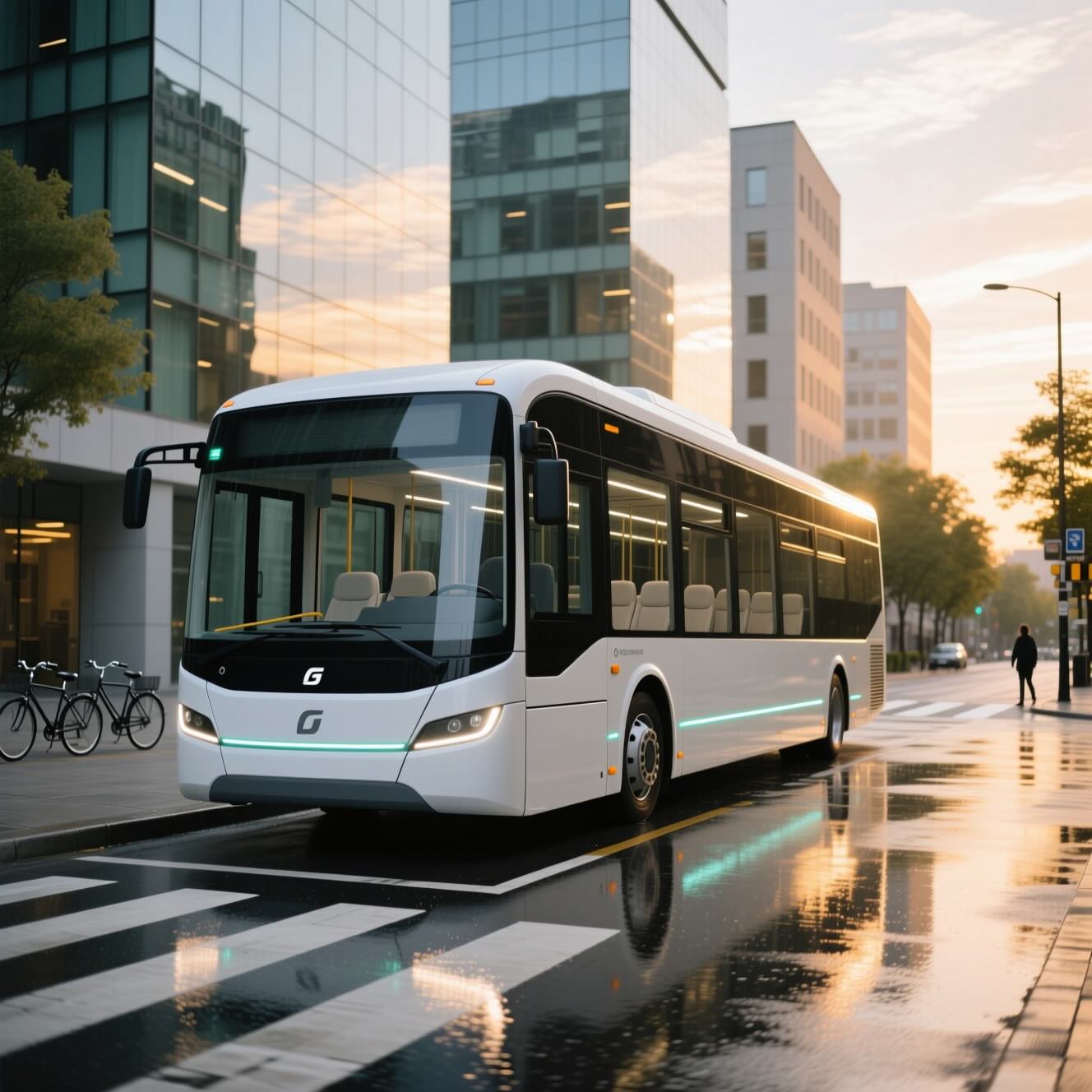
The paper introduces a new sustainability- and Industry 4.0-enhanced service quality model that uses advanced decision-making methods to evaluate and rank public bus options in Izmir, revealing electric buses as the most sustainable and highest-quality choice.
How to use this simulator (based on the 2025 Sustainability paper):
Public transportation is the lifeline of modern cities. 🚍🌆 It keeps people moving, reduces traffic, cuts emissions, and creates healthier urban environments. But how do we really know if a city’s transit system is performing well—especially in today’s era of sustainability and digitalization?
A new research study titled “Sustainable Public Transportation Service Quality Assessment by a Hybrid Bayesian BWM and Picture Fuzzy WASPAS Methodology: A Real Case in Izmir, Turkey” answers exactly that.
And wow—this work isn’t just another survey. It’s an ambitious attempt to reinvent how cities measure public transportation quality, bringing together sustainability, Industry 4.0 technologies, and advanced decision-making science. 🚌💡
Public transportation is more than buses and routes—it’s a system that affects:
♻️ Environmental sustainability
⏱️ Commuter efficiency
🧍♂️ Passenger comfort
🧑🦽 Accessibility
🤖 Digital innovation
💸 Economic viability
Cities like Izmir, Turkey, with millions of residents, rely heavily on buses. The local authority ESHOT runs around 2000 buses, including diesel, hybrid, gasoline, gas-powered, and increasingly—electric buses.
But with different technologies in the fleet, how do decision-makers know which bus type offers the best overall service quality?
That’s where this study comes in.
A brand-new model combining Sustainability + Industry 4.0 + Classic SERVQUAL
Traditionally, transportation service quality has been evaluated using the SERVQUAL model—focusing on things like reliability, responsiveness, empathy, tangibles, and assurance.
But today’s public transit operates in a totally new landscape:
So the authors expanded the classic model into something more modern and comprehensive:
It evaluates service quality under:
This huge structure includes:
Imagine evaluating everything from bus seat comfort to carbon emissions to cybersecurity. That’s the level of depth here! 🧠🔍
A Hybrid Decision-Making System Powered by Bayesian BWM + Picture Fuzzy WASPAS
Okay, the model is massive. But how do you actually calculate which bus is best?
They used a hybrid two-stage method:
Used to assign weights to all criteria.
Why Bayesian?
Experts decide which criteria are the most and least important (the “best” and “worst” criteria), and the Bayesian model calculates precise weight values.
This generates a realistic hierarchy of importance—because obviously, safety is more critical than, say, website design.
This stage takes the weighted criteria and ranks the bus alternatives.
“Picture fuzzy sets” allow experts to express:
This is more flexible than standard fuzzy logic and much more realistic for real-world evaluations, where people aren’t always 100% sure.
WASPAS (Weighted Aggregated Sum Product Assessment) then combines these into a final ranking.
In Izmir, the study compared:
So which one wins?
The final ranking clearly showed:
Electric buses offer the highest sustainable service quality overall.
—Study finding (Izmir case)
Here’s why electric buses stood out:
Despite a potentially higher initial expenditure, these options generate savings in the form of:
The research shows that when cities consider all aspects—environment, digital integration, safety, comfort, and economics—electric buses simply outperform the others.
Based on the Bayesian BWM analysis, certain factors consistently emerged as the most influential:
These correspond with global transportation priorities seen today:
🌱 Sustainability
🧠 Smart technology
🔐 Safety
⏱️ Efficiency
These still matter, but not as heavily:
This tells us that passengers and experts prioritize core performance and sustainability over cosmetic features.
This model gives cities a powerful decision-support tool to:
For a city like Izmir, this helps:
Other cities—especially rapidly urbanizing regions—can replicate the model instantly.
The research points toward exciting opportunities:
As electric buses lead the ranking, cities should:
Expect to see more solar-powered bus depots and wireless charging roads soon. ☀️⚡
Cities need to embed more digital tech:
Smart mobility will soon be the norm—not the exception. 🤖🚍
Beyond emissions, future evaluations should include:
SPT-SERVQUAL 4.0 already covers these in detail—and could evolve even further.
Future models could incorporate:
This methodology could become:
This research doesn’t just evaluate buses—it reimagines the entire thinking behind sustainable public transportation.
By combining:
…it provides a robust, future-ready framework for cities to make smart, sustainable transit decisions.
And the verdict is clear:
🚍💚 Electric buses are the strongest path toward sustainable, high-quality public transportation.
The future of urban transport is electric, intelligent, and sustainable—and it’s already on the road. 🌱⚡🚌
SERVQUAL 🧪 A model that measures service quality by comparing what customers expect with what they actually experience.
Industry 4.0 🤖 The modern digital revolution using AI, IoT, sensors, and automation to create smarter, more connected systems. - More about this concept in the article "The Rise of Smart Biomass 🌾 How Industry 4.0 Fuels Green Aviation".
Sustainability 🌱 Designing solutions that protect the environment, support society, and stay economically viable for the long term.
Bayesian Best–Worst Method (Bayesian BWM) 🎯 A mathematical tool that lets experts score criteria by defining the “best” and “worst” ones while handling uncertainty.
Picture Fuzzy Sets 🎨 A logic system that allows four types of responses—yes, no, maybe, and unsure—making human judgments more realistic.
WASPAS Method 📊 A decision-making method that ranks options by combining multiple criteria into one powerful evaluation score.
Multi-Criteria Decision-Making (MCDM) 🧠 A set of tools used to evaluate complex choices involving many factors, such as cost, safety, and sustainability.
Electric Bus ⚡🚌 A bus powered entirely by electricity, offering quiet operation and zero tailpipe emissions.
Hybrid Bus 🔋⛽ A bus that uses both an internal combustion engine and an electric motor, producing lower emissions than diesel.
Public Transportation Service Quality ⭐ A measure of how well a transit system performs based on comfort, safety, reliability, digital features, and environmental impact.
Source: Tumsekcali, E.; Taskin, A. Sustainable Public Transportation Service Quality Assessment by a Hybrid Bayesian BWM and Picture Fuzzy WASPAS Methodology: A Real Case in Izmir, Turkey. Sustainability 2025, 17, 10735. https://doi.org/10.3390/su172310735
From: Duzce University; Yildiz Technical University; Azerbaijan State University of Economics.