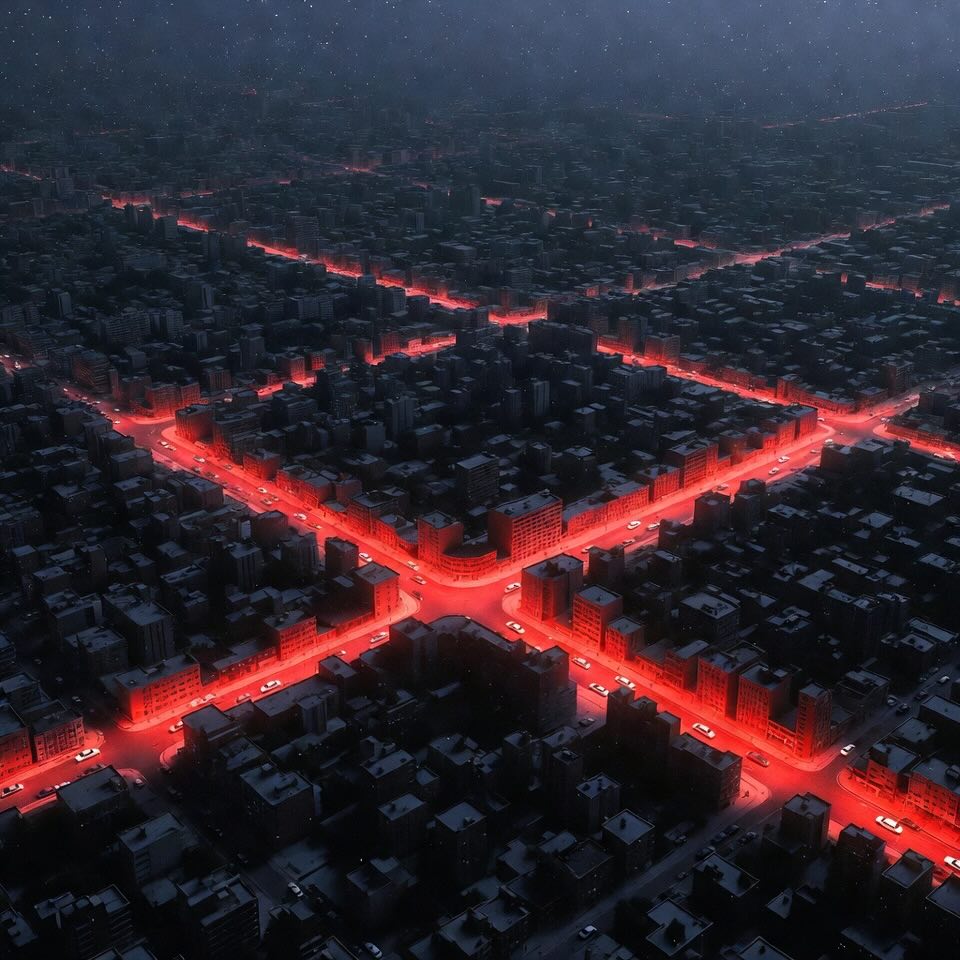
The research presents ME-FCN, an innovative neural network leveraging multi-scale feature enhancement and attention mechanisms to achieve highly accurate and efficient building footprint extraction from complex remote sensing images, revolutionizing urban mapping and planning.
In the fast-paced world of urbanization, accurate building footprint extraction from remote sensing images is no longer a luxury—it's a necessity. A novel neural network, ME-FCN (Multi-scale Feature-Enhanced Fully Convolutional Network), is here to revolutionize urban planning, smart city development, and much more!
Remote sensing images provide an incredible bird’s-eye view of urban landscapes, but they're also riddled with complexities:
Traditional methods like analyzing texture or shape often fall short due to these challenges. Enter deep learning, the game-changer in semantic segmentation!
The research introduces ME-FCN, a cutting-edge neural network designed specifically for high-accuracy building footprint extraction. It shines where others falter by incorporating multi-scale feature enhancement and attention mechanisms.
ME-FCN is a precise, robust, and efficient tool for building footprint extraction, leaving traditional methods in the dust.
The researchers tested ME-FCN on three diverse datasets:
The performance was measured using metrics like Overall Accuracy (OA), Precision, Recall, F1-score, and Intersection over Union (IoU). Spoiler alert: ME-FCN excelled across the board.
What sets ME-FCN apart visually? It delivers:
Figure comparisons consistently showed ME-FCN outclassing alternatives like U-Net and MANet. It's not just a win—it's a landslide victory!
Accurate urban mapping is foundational for smart city initiatives. ME-FCN provides the precision needed for planning sustainable infrastructure.
In disaster-stricken areas, ME-FCN can identify affected buildings swiftly, aiding recovery efforts.
With its robust design, ME-FCN is primed for integration into real-time monitoring systems for urban growth and illegal construction detection.
While ME-FCN is a groundbreaking tool, the journey doesn't stop here. Future research can:
ME-FCN redefines building footprint extraction with its innovative architecture and stellar performance. Whether it’s urban planning, disaster recovery, or smart city development, this network is paving the way for a brighter, more efficient future.
Building Footprint - The outline or shape of a building as seen from above in satellite images, used for mapping and urban planning.
Remote Sensing - The technology of capturing images and data from a distance—like snapping pics of Earth using satellites or drones.
Semantic Segmentation - A computer vision technique that labels every pixel in an image, helping AI understand "what is where" (e.g., separating buildings from roads).
Deep Learning - A branch of AI that uses neural networks to learn patterns in data, like spotting buildings in aerial photos. - Get more about this concept in the article "Machine Learning and Deep Learning | Unveiling the Future of AI".
Multi-Scale Features - Different levels of detail in an image, from big-picture context to tiny edges, crucial for accurate building detection.
Attention Mechanisms - Smart algorithms that help AI focus on the most important parts of an image—like ignoring background noise to zero in on buildings.
Sheng, H.; Zhang, Y.; Zhang, W.; Wei, S.; Xu, M.; Muhammad, Y. ME-FCN: A Multi-Scale Feature-Enhanced Fully Convolutional Network for Building Footprint Extraction. Remote Sens. 2024, 16, 4305. https://doi.org/10.3390/rs16224305
From: China University of Petroleum (East China); Land Surveying and Mapping Institute of Shandong Province.